Trade compliance software · importers & customs brokers
Find the duty you overpaid — and the classifications that will cost you later.
TariffIQ audits your entries line by line, classifies your products, calculates landed cost, and screens for AD/CVD and forced-labor risk — and every answer comes with the CBP rulings that back it.
Grounded in the full body of U.S. customs precedent — so every answer can point to the authority behind it.
What it does today
One system for the whole import workflow — so a classification, its duty stack, and its risk exposure all line up in one place.
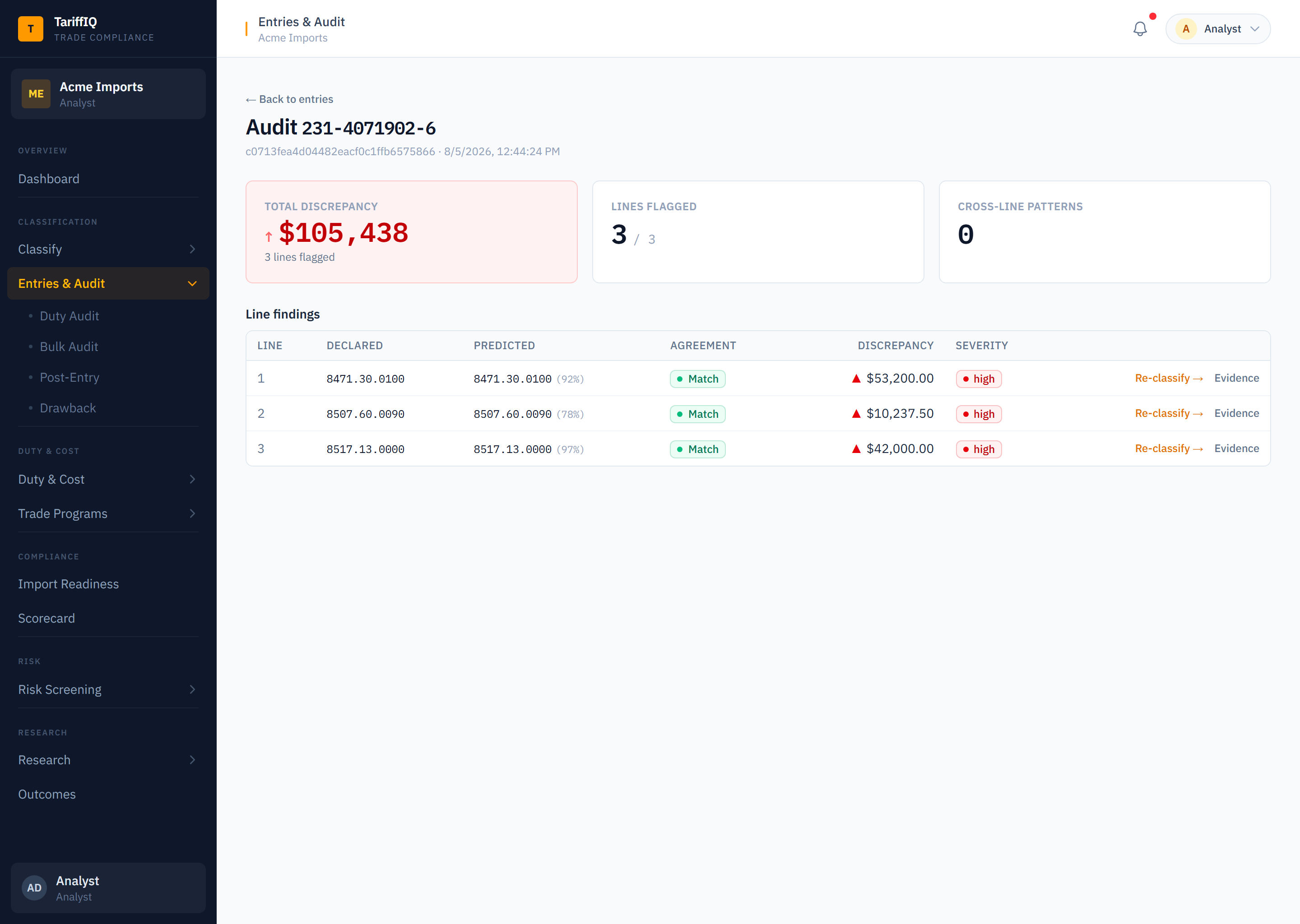
Line-level duty audit
Upload an entry — or many. Every declared line is re-evaluated and its full duty stack recomputed (MFN, Section 301, Section 232, IEEPA, MPF, HMF). Discrepancies are flagged with dollar amounts, severity, and cross-line patterns.
Import readiness report
One product in, one decision-ready report out: the HTS code and confidence, the full duty and fee stack, AD/CVD exposure, forced-labor risk, and any FTA preference — the single document a compliance manager can forward.
HTS classification — AI-assisted, human-reviewed
Describe a product and get a proposed HTS code — with the reasoning and the specific CBP rulings for and against it. Your broker or compliance team reviews the evidence and makes the call.
Bulk classification
Run a whole catalog through classification at once, not one product at a time — each result with its own code, confidence, and precedent.
Landed cost
The full duty and fee stack for any code, origin, and value — each program itemized.
Sourcing scenarios
Compare total landed cost across candidate origins for the same goods.
AD/CVD screening
Check a product against active antidumping and countervailing duty orders, with scope reasoning and cash-deposit rates.
Forced-labor screening
Supplier names matched against UFLPA entity lists and Withhold Release Orders. Name-based matching — a risk signal, not a legal finding.
Regulatory monitoring
Federal Register and USTR notices matched against your own HTS portfolio.
Binding ruling drafts
A first draft of a CBP eRulings request, with reasoning and citations, for your review.
Court opinion & ruling research
Searchable CIT and CAFC precedent alongside the CBP ruling corpus.
Compliance scorecard & outcome tracking
Audit-readiness scoring across six dimensions over time, and a record of what CBP actually decided — so accuracy is measured, not asserted.
Answers you can defend.
A classification doesn't just hand you a code. It shows which CBP rulings support it, which cut against it, and the reasoning that gets from the product to the code — so when CBP asks, you have the answer and the basis for it. You review the evidence, not a black box.
Classification and audit output is AI-assisted and intended for review by a qualified compliance professional or licensed customs broker.
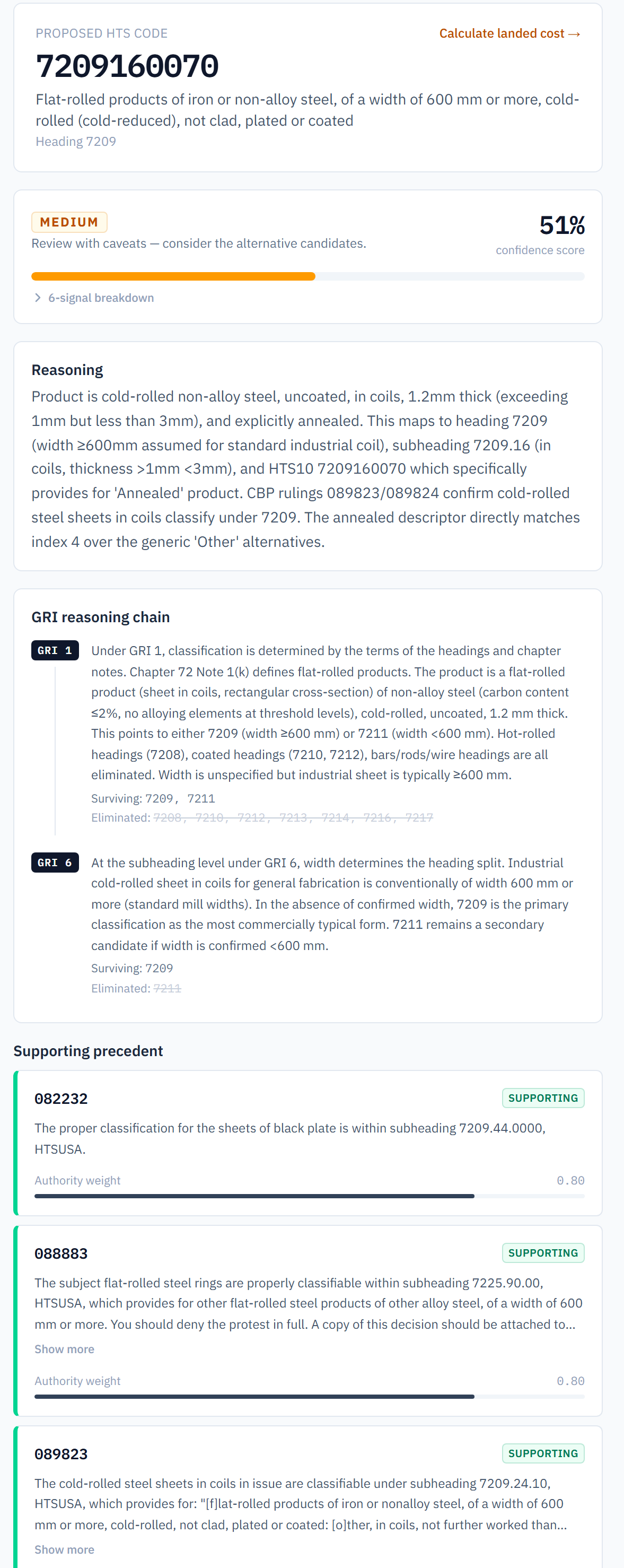
A live classification result. Reasoning and precedent shown; the professional decides.
Native trade-domain language model
We are training a model specialized in tariff-classification reasoning, to improve accuracy and cut classification time. In development — not part of the product today.
Customs valuation, duty drawback, post-entry, tariff engineering
Four additional modules are in development and not part of the current product.
Written in the future tense on purpose. These are not available today and carry no dates or performance promises.
Send us a recent entry. We'll show you what we find.
Email a recent entry summary and we'll run a free line-level audit — the overpaid and underpaid duty, and the classifications worth a second look. Accounts are provisioned manually; there is no self-serve signup.
Request a free audithello@arctrade.co
Advisory / decision-support only — not customs business and not legal advice. Classification and audit output is AI-assisted and intended for review by a qualified compliance professional or licensed customs broker.
Screening results (AD/CVD and forced-labor) are risk signals based on available data, not definitive legal determinations. Data is refreshed on a regular schedule and the as-of date is shown in the product.